


KiperAid Industry Report: Camping Tents and Outdoor Living from 2025 to 2035
For millions of outdoor enthusiasts, a tent is more than just a piece of gear. It's the frontline of adventure—a private sanctuary from the noise of everyday life, and the place where real connections happen. For the broader outdoor industry, the tent market serves as a reliable barometer. Where it grows, why it grows, and what consumers are actually buying tells us everything about where outdoor recreation is headed.
At Kiperaid, we track these market shifts closely. Because building great gear isn't just about what happens in the design studio—it's about understanding the forces shaping the entire industry. The following analysis draws on market data from Global Market Insights (GMI) and cross-validated third-party research to paint a clear picture of the global camping tent landscape in 2025: which regions are driving growth, what's fueling it, and what the tents of tomorrow will look like.
1. Market Overview: A $4.4 Billion Starting Point, With a Decade of Growth Ahead
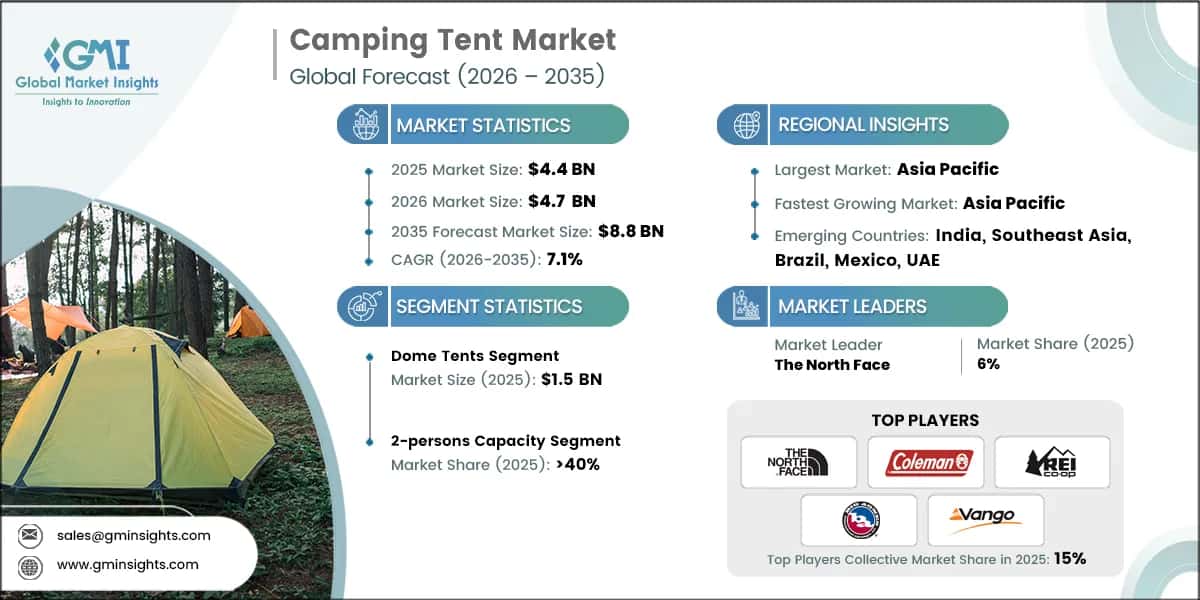
Let's anchor this with the numbers that matter. According to GMI, the global camping tent market is projected to reach $4.4 billion in 2025, and from 2026 to 2035, it's expected to grow at a compound annual growth rate (CAGR) of 7.1% to $8.8 billion by 2035.
A quick note on methodology: different research firms report slightly different absolute figures depending on whether they include non-recreational categories like emergency relief tents or construction-site shelters in their definition. GMI's numbers are intentionally conservative—they count only tents designed for outdoor recreation camping. But here's what every major research firm agrees on: this market is on a decade-long growth trajectory. Asia-Pacific is growing the fastest. North America remains the single largest national market. And the underlying shift—camping moving from a niche pursuit to a mainstream lifestyle—is now undeniable.
1.1 Three Engines Powering Global Growth
Three regions—Asia-Pacific, North America, and Europe—together account for over 80% of global market share. Each one is growing, but for very different reasons.
-
Asia-Pacific: In 2025, this region holds roughly 28% of the global market, or about $1.4 billion. It's the fastest-growing region by a wide margin, with a projected CAGR of 8.4%. China alone accounts for more than half of the region's tent sales.
-
North America: The single largest regional market at roughly 34% of the global total. Growth here is steady rather than explosive, driven by a deeply embedded outdoor culture and a consumer base that consistently trades up to higher-quality gear. The United States alone represents 88% of the North American market, with tent sales reaching $1.2 billion in 2025.
-
Europe: Holding 23% of global market share in 2024, Europe remains a pillar of the global tent market. Growth is driven by two distinct forces: rising demand for sustainable products and the enduring European tradition of multi-day family camping trips.
1.2 Product Segmentation: The End of One-Size-Fits-All
The days of a single tent design covering every outdoor scenario are over. According to GMI data, three tent types—dome tents, tunnel tents, and geodesic tents—together account for more than 80% of global sales in 2025. But their dominance varies dramatically by region and use case.
-
Dome tents are the global mainstream. They're reasonably light, easy to pitch, and available at virtually every price point, from solo backpacking models to 4-person family versions. For most campers, they're the safest and most versatile choice.
-
Tunnel tents shine in specific scenarios, particularly family camping in Europe. They offer more interior space and better livability for extended stays. In countries like Germany and France, where multi-day family camping trips are the norm, tunnel tents have captured market share that rivals or even exceeds dome tents.
-
Geodesic tents dominate the professional segment. Their multi-pole intersecting structure is purpose-built for extreme conditions—high winds, heavy snow loads, alpine environments. In markets like the Rockies or the Alps, where performance requirements are non-negotiable, geodesic tents command a far higher share than the global average.
The underlying shift is fundamental: the industry has moved from a product-centric model—"here's what we make, buy it"—to a scenario-centric one—"tell us how you camp, and we'll build the tent that fits."
2. Regional Deep Dive: Three Markets, Three Growth Logics
The differences between North America, Europe, and Asia-Pacific aren't subtle. They're shaped by decades of distinct outdoor traditions, varying levels of campground infrastructure, and post-pandemic shifts in consumer behavior.
2.1 North America: Premium Upgrades in a Mature Market
North America is the ballast of the global tent market. It's not just the largest—it's the most deeply rooted.
According to the Outdoor Industry Association, over 57 million American households participated in camping in 2023—that's more than 45% of all U.S. households. The National Park Service reported a 15% year-over-year increase in visitors, with over 60% choosing camping as their primary accommodation. This level of participation is supported by a mature ecosystem: from national parks to private campgrounds, from specialty outdoor retailers to big-box stores, camping gear has shelf space and demo opportunities that are unmatched anywhere else in the world.
But the more important story is the shift in what people are buying. Mid-to-high-end tents now account for over 50% of the North American market, a figure well above other regions. Experienced campers here are less price-sensitive—they prioritize performance, durability, and scenario-specific features. Three criteria dominate purchase decisions: lightweight portability without sacrificing durability, all-weather reliability, and fast, intuitive setup. The sweet spot for pricing falls between $100 and $500, which together drive nearly 60% of sales.
Looking ahead, the U.S. Great American Outdoors Act—which allocates nearly $10 billion to upgrade national park campgrounds, trails, and amenities—is expected to boost family camping participation by at least five percentage points. At the same time, the camper demographic is skewing toward higher-frequency, longer-distance, and more technically demanding trips—trends that will continue pushing demand toward premium gear.
2.2 Europe: Where Sustainability Meets Family Tradition
Europe is where modern camping culture was born, and the market here reflects both deep tradition and forward-looking values.
Germany, France, the UK, and the Nordic countries together account for over 65% of the European tent market. Camping is woven into the fabric of leisure life—from the German family holiday to the Nordic "everyman's right" that allows free camping on most public lands. Infrastructure is comprehensive: from Alpine mountain campsites to Mediterranean coastal grounds, almost every outdoor destination has a developed camping facility.
Yet Europe's defining feature is fragmented consumer demand. German buyers gravitate toward tunnel tents for family trips. The UK market is seeing a surge in glamping-style tents. Nordic countries, with their growing winter camping scene, are driving demand for four-season technical tents.
More significantly, Europe leads the world in sustainable camping consumption. Third-party research indicates that eco-friendly tents—those made with recycled polyester, environmentally safe dyes, and solvent-free waterproof coatings—surpassed 32% market share in Europe in 2023, with Germany and France scoring even higher. This isn't just a consumer preference anymore; it's being institutionalized. Major European outdoor retailers now use "eco-materials" as a core merchandising criterion. As EU environmental regulations tighten further, tents that fail sustainability standards will increasingly find themselves locked out of the mainstream market.
2.3 Asia-Pacific: The Breakout Growth Story
Asia-Pacific isn't just growing—it's reshaping the global market. With a projected CAGR of 8.4%, it's the fastest-growing region, and by 2025 it already rivals North America in total market share at 28%. China accounts for more than half of regional sales, roughly $400 million.
What makes this growth unique is that it's being driven by three forces that have never converged in this way in any other market:
First, a post-pandemic reset in leisure preferences. Urban consumers across the region have made camping their go-to short-haul vacation choice. It satisfies the deep desire for nature immersion while inherently avoiding large crowds—a combination that traditional tourism can't easily match.
Second, rapid middle-class expansion. The Asia-Pacific middle class, led by China, is growing faster than anywhere else. These consumers have disposable income for quality gear and are eager to experiment with "camping plus" experiences—camping combined with hiking, landscape photography, or gourmet outdoor cooking.
Third, a campground infrastructure boom. The number of developed campsites in China has exploded in recent years, with the vast majority located within a 1-2 hour drive of major cities. This radically lowers the barrier to entry. Third-party sales data reflects the surge: tent sales in China nearly doubled over a two-year period.
However, the Asia-Pacific market is still in rapid flux. Demand is polarized: at the entry level, pop-up tents and inflatable models that emphasize speed and affordability are seeing explosive growth. At the premium end, established outdoor brands with strong reputations are gaining traction among serious enthusiasts and glamping aficionados alike. The long-term outlook is underpinned by continued middle-class growth, ongoing campground development, and the rise of competitive local brands.
2.4 Regional Comparison at a Glance
| Dimension | North America | Europe | Asia-Pacific |
|---|---|---|---|
| Dominant Scenarios | Backpacking, long-distance hiking, family car camping | Multi-day family camping, glamping, mountain trekking | Short-haul suburban camping, social/photo camping |
| Core Product Preferences | Lightweight, all-weather performance, fast pitch | Eco-materials, spacious interiors, wind resistance | Quick pitch, aesthetic design, high value |
| Dominant Tent Types | Dome, ultralight backpacking, geodesic | Tunnel, dome, cabin-style | Dome, pop-up, inflatable |
| Key Purchase Factors | Brand credibility, weight, weather protection, packability | Sustainability, interior space, durability, wind stability | Price, ease of setup, appearance, online reviews |
The core insight is this: mature markets (North America, Europe) are driven by replacement and upgrade cycles—consumers already own a tent and are looking for something better, lighter, more specialized. Emerging markets (Asia-Pacific) are driven by new participation—first-time campers entering the hobby and looking for accessible, affordable, easy-to-use gear. Any brand with global ambitions needs to understand and respect this fundamental difference.
3. The Core Growth Drivers: Four Forces Converging
A decade of sustained market growth doesn't happen by accident. Four interconnected forces are at work.

3.1 Lifestyle Shift: From Sightseeing to Immersive Camping
The deepest driver is a fundamental change in how people choose to spend their leisure time. Traditional hotel-and-sightseeing tourism is losing ground to experience-based outdoor recreation.
GMI consumer surveys found that over 60% of campers choose the activity primarily because it offers "a more immersive connection with nature." Nearly half said camping was one of the few leisure activities they felt comfortable participating in after the pandemic. This isn't a temporary blip—it's a structural shift. And it's translating directly into gear purchases: among consumers who already own a tent, over 30% plan to replace or add a new one within two years—a replacement rate significantly higher than for other outdoor gear categories. The primary reason isn't product failure; it's that their current tent no longer matches their evolving camping style.
3.2 Policy and Infrastructure: Governments Bet on the Outdoors
Camping can't grow without places to camp. Governments across all three major markets are investing accordingly.
-
North America: The Great American Outdoors Act directs nearly $10 billion toward national park campground upgrades—more sites, better utilities, WiFi coverage, and trail improvements. Industry analysts estimate this alone will boost family camping participation by at least five percentage points.
-
Europe: France, Germany, and others have launched eco-tourism initiatives that include campground modernization. The EU's green tourism certification system now evaluates campgrounds on both environmental and service standards, raising the bar across the board and attracting higher-spending visitors.
-
Asia-Pacific: China, Japan, and South Korea have all introduced camping industry development plans, integrating campground construction into broader tourism strategies. The focus isn't just on adding tent pads—it's on building out full-support infrastructure: restrooms, showers, convenience stores, and proper site management.
3.3 Product Innovation: Lowering Barriers, Raising Experiences
Innovation is the internal engine of market growth, and the tent industry has undergone what amounts to a generational leap in the past few years.
Materials: Ripstop nylon, silicone-coated fabrics, carbon fiber poles, and aluminum alloys are now standard in mid-to-high-end tents. These materials simultaneously improve waterproofing, wind resistance, and tear strength while cutting weight—some premium models now come in under one kilogram.
Structural design: Pre-connected pole systems, hydraulic-assisted frames, and inflatable beam technology have made setup dramatically faster. Some pop-up models can be fully pitched in under 60 seconds. GMI research shows that nearly half of new campers rank "ease of setup" as their number-one purchase criterion.
Functional integration: Solar charging panels, integrated LED lighting, thermal insulation layers, and modular designs that let campers customize their setup are increasingly common. According to GMI, tents incorporating these kinds of innovations—speed, weight savings, eco-materials, all-weather protection—now account for over half of global sales by value, and that percentage is still climbing. An interesting sub-trend worth watching: the rise of smart camping lighting. Campers are increasingly looking for lanterns that do more than illuminate—they want intelligent dimming, extended battery life, and the ability to charge devices in the field, all in one unit. It's a small category, but it signals where broader consumer expectations are heading.
3.4 Scenario Fragmentation: From "It Works" to "It's Perfect for My Trip"
The days of "one camping style" are over. The activity has splintered into dozens of distinct scenarios—family camping, ultralight backpacking, glamping, car camping, winter camping, bike-packing—and each one demands different things from a tent.
This fragmentation is now visible at retail: U.S. specialty stores are organizing tent displays by use case rather than brand. European chains are training staff to recommend tents based on a customer's specific camping style. The shift from "a tent that works" to "a tent that's perfect for my kind of camping" is a powerful engine of upgrade demand, driving replacement cycles and new purchases alike.
4. Competitive Landscape: A Tale of Two Strategies
The tent market's competitive structure is evolving into a clear barbell shape: concentrated power at the top among global giants, and a thriving ecosystem of niche specialists at the other end.
4.1 The Heavyweights Hold Their Ground
According to GMI, the top five global brands collectively hold an estimated 10-15% of the market, and that concentration is gradually increasing. The major players include:
-
The North Face: The premium leader, built on technical expertise—geodesic designs, advanced materials, and proven performance in extreme conditions.
-
Coleman: The mass-market titan, with an unmatched product range spanning entry-level to mid-premium, and distribution that reaches from big-box retailers to e-commerce platforms across North America and Europe.
-
REI Co-op: The vertically integrated retail brand. REI leverages its massive membership base and retail footprint to develop high-value exclusive tent lines that compete strongly in the mid-to-premium segment.
-
Big Agnes: The specialist's specialist, with deep expertise in ultralight tents. Strategic collaborations with brands like The North Face have amplified its technical edge.
-
Vango: Europe's homegrown champion, with intimate knowledge of regional consumer preferences and a distribution network that international brands struggle to match.
These brands are increasingly moving away from "one global product, one global message" toward multi-product portfolios tailored to specific regional markets.
4.2 The Niche Players Find Their Edge
While the giants consolidate, a wave of smaller brands is thriving by targeting the gaps. Niches like bikepacking, ultralight thru-hiking, and vehicle-based camping are too small to justify dedicated product lines from a Coleman or The North Face—but they're large enough to sustain a focused specialist. The competitive advantage here isn't scale; it's deep understanding of a specific user and the ability to iterate fast.
Chinese brand Mobi Garden is a textbook example: it read the domestic market's demand for affordable, easy-to-use gear, embraced e-commerce and livestream selling early, and built a dominant position among new campers. Another notable path comes from emerging brands like Kiperaid, which have taken an even more targeted approach—focusing on verticals like camping lighting and smart outdoor electronics. By combining smart features with aggressive value, they've achieved product iteration cycles that traditional giants simply can't match, carving out a distinct brand identity in a crowded field.
4.3 New Variables Reshaping the Playing Field
Three newer dynamics are rewriting the rules:
-
E-commerce ubiquity: It's never been easier for a small brand to reach consumers directly. A well-executed content strategy on social platforms can build niche brand awareness that once required a national retail footprint.
-
The DTC advantage: Direct-to-consumer models eliminate intermediaries, giving brands direct access to user feedback. Product improvements that used to take seasons can now happen in weeks—a speed advantage that legacy supply chains struggle to replicate.
-
Cross-regional brand migration: While Western brands have long adapted products for Asian markets, the reverse is now happening. Asia-Pacific brands are taking the value and smart features honed in their home markets and adapting them for North American and European consumers—creating a new kind of competitive pressure from an unexpected direction.
5. The Trends That Will Define Tomorrow's Tents
GMI's forecast data, combined with current product innovation trajectories, points to three defining trends.
5.1 Ultralight: The Eternal Pursuit of Less Weight, More Strength
Lightweight design is the most predictable and enduring trend in the industry. The goal isn't just cutting grams—it's doing so without sacrificing durability or weather protection.
In 2025, ultralight tents account for 40% of the global market, and that figure is expected to reach 45% by 2030. The material science behind this is impressive: high-strength fabrics in stress zones, ultralight materials elsewhere, and carbon fiber or aluminum alloy poles replacing heavier steel. For backpackers and long-distance hikers, sub-one-kilogram tents that still hold up in a storm aren't a fantasy anymore—they're on the shelf.
5.2 Smart Features: When Your Tent Becomes a Connected Hub
Smart technology is the next frontier, and early adoption is happening in three areas:
-
Environmental sensing and control: Solar-integrated power systems, app-controlled LED lighting, smart ventilation, and air quality monitoring that adjusts airflow automatically.
-
Convenience engineering: Hydraulic frames that enable one-minute pitches, integrated wireless charging pads, Bluetooth audio, and other quality-of-life features.
-
Safety systems: Emergency beacon integration, environmental sensors that track weather shifts and internal conditions, and companion apps that deliver real-time alerts.
Smart tents are still a small slice of the overall market, but every major brand is investing in this direction. It's widely seen as the key differentiator for mid-to-premium products in the coming years. And this shift extends beyond tents themselves. Kiperaid, for instance, is among the brands redefining what a camping lantern can be—transforming it from a simple light source into a compact energy hub with intelligent dimming, multi-day battery life, and emergency device charging. Combine that with inflatable and hydraulic quick-pitch systems that make setup nearly instant, and the broader direction is clear: the industry is converging on a single question—how can technology make outdoor life simpler, safer, and genuinely more enjoyable?
5.3 Sustainability: No Longer Optional
Sustainability has moved from marketing angle to market requirement. Nearly one in three European consumers actively prefer eco-friendly camping gear. In North America, the figure is approaching one in five.
The industry response is comprehensive: recycled polyester and regenerated nylon fabrics, solvent-free waterproof coatings, fluorine-free DWR treatments, recyclable aluminum poles, biodegradable plastic components, and minimal, plastic-free packaging. By 2025, over 30% of tents sold globally incorporate eco-materials; in Europe, that figure exceeds 35%. At the retail level, sustainability is becoming a filter: products that don't meet environmental standards are steadily losing shelf space and, increasingly, market access.
6. A Practical Buying Guide: Match Your Tent to Your Terrain
Based on the regional and scenario analysis above, here's a quick-reference guide for choosing the right tent. The golden rule: there is no "best tent"—only the tent that's best for where and how you camp.
6.1 North America: Prioritize Lightweight, Technical Performance
-
Backpacking: Ultralight dome or technical backpacking tent. Target weight under 2 kg. Top brands: Big Agnes, The North Face.
-
Family car camping: Spacious dome or cabin-style tent with fast setup. Top brands: Coleman, REI Co-op.
-
Alpine/expedition: Geodesic tent for extreme weather stability. Top brands: The North Face.
6.2 Europe: Prioritize Eco-Friendly, Sturdy, Spacious Designs
-
Multi-day family camping: Tunnel tent or large dome with separate sleeping compartments and strong wind performance. Top brands: Vango, Coleman.
-
Glamping: Cabin-style or large dome with premium aesthetics and eco-materials. Top brands: Vango.
-
Mountain trekking: Geodesic tent. Top brands: The North Face, Hilleberg.
6.3 Asia-Pacific: Prioritize Value, Speed, and Ease of Use
-
Short-haul suburban camping: Pop-up or inflatable tent with 60-second setup and compact pack size. Top brands: Mobi Garden, Decathlon.
-
Social/glamping: Aesthetic dome or cabin-style tent that looks great in photos.
-
Intermediate/advanced: Lightweight dome or backpacking tent for multi-scenario versatility.
A simple three-step process for any buyer: Define your primary camping scenario → Match it to the dominant tent type for your region → Choose a specific model based on your feature priorities and budget.
How to choose a tent?
The Bottom Line
The global camping tent market is being shaped by a simple but powerful dynamic: different regions are at different stages of camping maturity, and their needs are fundamentally different. Mature markets upgrade. Emerging markets expand. Both are growing.
For the industry, the path forward runs through lighter materials, smarter features, and genuine sustainability—not as buzzwords, but as product realities. For campers, the future means gear that's more precisely matched to individual styles and scenarios than ever before. There is no universal "best"—only the tent that's best for your kind of adventure.
*Kiperaid is an Asia-Pacific-based camping gear brand built around two core principles: smart functionality and honest value. We specialize in camping lighting and quick-pitch equipment designed to lower the barriers to outdoor adventure without compromising on quality or experience.